As even a cursory perusal of this site will tell you, we love German wines. Here's an interesting article on some of the innovations in German wine-making currently in progress.
We're particularly taken with the picture illustrating the use of a glass stopper instead of a cork. That's a new one on us!
The pertinent passage:
Embracing new trends doesn't mean having to forego tradition. Hans-Josef Becker uses many of the same techniques as his grandfather. At the same time, he's not afraid to tinker. He was the first German grower to use glass stoppers instead of corks.
"It's really easy to remove the glass stopper," Becker said. "And you can close it again so that you can put the bottle in the refrigerator."
Becker decided to switch to glass stoppers because of the declining quality of natural corks: the more delicate a wine is, like the dry Rieslings in his region, the more sensitive it is to unpleasant aftertastes or changes that can come about because of the cork. The glass stoppers have helped avoid spoiled bottles and won over customers.
Interesting. We wonder if we'll see any of these glass-stoppered wines over here?
Saturday, October 22, 2005


Sunday, October 16, 2005
The German Wine Society at the German Club
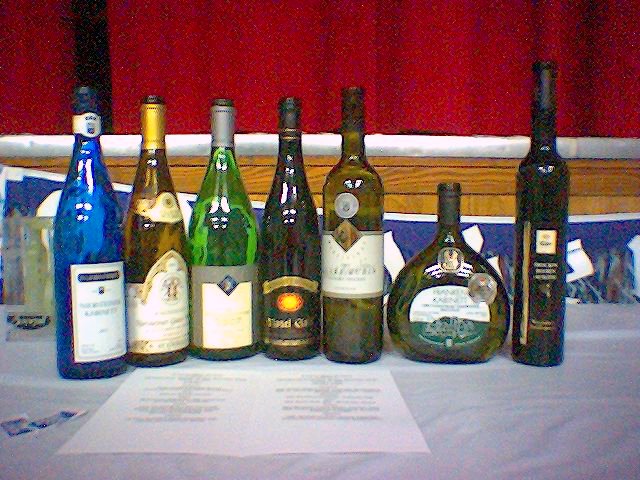
The wines we had at the German Wine Society event at the German Club (from left to right in order of tasting and description below)
Last night we attended the German Wine Society of Regina's dinner and tasting at, appropriately enough for October, the German Club. The traditional Oktoberfest beverage was not in evidence, but lots of good wine certainly was, and an absolutely delicious dinner that kept us surprised and delighted all evening long.
Here are our notes on the wine, pictured, alas, only in the accompanying low-res photograph from our Audiovox Harrier (from left to right, in the order we tasted them):
Reception
Gustav Adolf Schmitt Kabinett, Rheinhessen, 2001
Margaret Anne wasn't big on this, finding it a little thin for a Kabinett. Ed tasted lots of sweet apple to begin with, but for some reason the finish was rather sour and bitter. Alice (Margaret Anne's mom, not our four-year-old daughter, who, although present at the dinner, likes her grape juice unfermented) also found it nice and fruity, but also didn't like the aftertaste.
Last night we attended the German Wine Society of Regina's dinner and tasting at, appropriately enough for October, the German Club. The traditional Oktoberfest beverage was not in evidence, but lots of good wine certainly was, and an absolutely delicious dinner that kept us surprised and delighted all evening long.
Here are our notes on the wine, pictured, alas, only in the accompanying low-res photograph from our Audiovox Harrier (from left to right, in the order we tasted them):
Reception
Gustav Adolf Schmitt Kabinett, Rheinhessen, 2001
Margaret Anne wasn't big on this, finding it a little thin for a Kabinett. Ed tasted lots of sweet apple to begin with, but for some reason the finish was rather sour and bitter. Alice (Margaret Anne's mom, not our four-year-old daughter, who, although present at the dinner, likes her grape juice unfermented) also found it nice and fruity, but also didn't like the aftertaste.
St. Ursula Niersteiner Gutes Domtal Kabinett, Rheinhessen, 2000
We all preferred this to the Schmitt; it just seemed to have more characters. Someone at the table said it was sweeter than the first one, although Ed didn't think so. His comment was that it definitely had that "gasoline" or "diesel" bouquet that is typical of some Reislings--but he meant that in a good way.
Martinshof Huxelrebe Kabinett, Pfalz, 2003
We last had this at the German Wine Society tasting at the Willow on Wascana. We adored it then, and ordered four one-litre bottles through the GWS when it put in its group order to Germany. We haven't opened one of those yet, but we will soon, because this was, without a doubt, or favorite wine of the evening (with the possible exception of the dessert choice). It had a rich, rich mouth feel and a wonderful caramel flavor. It was a perfect pairing with the appetizer. "Beautiful" was the most common comment around the table. Someone else at the event claimed the taste was rhubarb, but to us, it's unmistakeably caramel. (Ed really doesn't like rhubarb, so he would never insult a wine he enjoyed by referencing what he calls "mutated celery.")
Soup: German Mussel Chowder
Mosel Gold QBA, Mosel Saar Ruwer, 2002
The weakest wine we'd yet had. "A bit musty," said Margaret Anne. To be fair, it didn't go too badly with the soup, although it certainly wasn't as inspired a match as the Huxelrebe with the herring (and, in fact, according to Margaret Anne, who'd hung on to some of hers, the Huxelrebe went better with the soup than the Mosel Gold did).
Entrée: Pork Tenderloin in a Rye Crust with Honey German Mustard Sauce, Served on a Bed of Herbed Spaetzle with German Rosette Beets
Martinshof Cuvee Ruben Trocken, Pfalz, 2003 Frickenhauser Kapellenberg Kabinett Bacchus, Franken, 1999
The Frickenhauser Kapellenberg Kabinett Bacchus, which comes in the traditional Franken flagon-shaped bottle, smelled and tasted like pine resin. It was thin and uninteresting to both of us, and the food didn't make it any better. (To be fair, some people at the event thought it went better with the entree than the red did. We strongly disagreed.)
Dessert: German Brandied Apple Pancakes with Caramel and Chocolate Sauce
Heinheimer Kafer Ortega Sybilstein Trockenbeerenauslese (TBA), Rheinhessen, 1998
As beautiful as one would expect. Deep gold colour. Rich, buttery mouth feel. Very sweet, of course, with strong flavours of honey and raisin, but still a touch of acidity to keep it from being cloying. Margaret Anne summed it up simply: "It's a great dessert wine." Ed, who strongly believes dessert wines should be enjoyed on their own rather than trying to match them to desserts, drank his before dessert even arrived. Margaret Anne still had some of hers, and pronounced the combination of the wine and the brandied apple pancakes one of the better dessert/wine pairings she's run across.
Dessert: German Brandied Apple Pancakes with Caramel and Chocolate Sauce
Heinheimer Kafer Ortega Sybilstein Trockenbeerenauslese (TBA), Rheinhessen, 1998
As beautiful as one would expect. Deep gold colour. Rich, buttery mouth feel. Very sweet, of course, with strong flavours of honey and raisin, but still a touch of acidity to keep it from being cloying. Margaret Anne summed it up simply: "It's a great dessert wine." Ed, who strongly believes dessert wines should be enjoyed on their own rather than trying to match them to desserts, drank his before dessert even arrived. Margaret Anne still had some of hers, and pronounced the combination of the wine and the brandied apple pancakes one of the better dessert/wine pairings she's run across.
A delicious end to a delicious evening!
Thursday, October 13, 2005
Tuesday, October 11, 2005
Martinshof Gewürztraminer Spätlese 2003
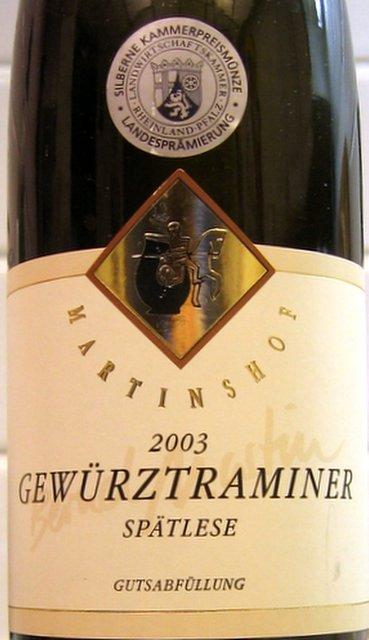
Martinshof Gewürztraminer Spätlese 2003
A wine we ordered direct from Germany through the German Wine Society, this Martinshof Gewürztraminer was everything we like in German wine. Lichee, sweet apple, with a nice, non-acidic mouth feel. Full-flavoured, and a long, long finish. Yum! We give this a solid 8/10 and would definitely buy it again.

Au Bon Climat Pinot Noir 2003

Au Bon Climat Pinot Noir 2003
This Au Bon Climat Pinot Noir from California's Santa Maria Valley, purchased on the recommendation of the staff at a Calgary wine store while we were there this summer (it's not one we've seen locally), has a deep garnet colour, a lovely and big bouquet and a big but nicely balanced flavour to match. Cherries came to mind predominantly, but it was hard to pick out a lot of individual notes from the harmonious whole of the taste. Our rating: 7.5/10. We'd definitely buy it again, given the opportunity.
Vineland Estates Chardonnay 2004

Vineland Estates Chardonnay 2004
We've joined the Vineland Estates wine society, through which we receive two bottles of wine each month, and a complementary recipe, for $35. Vineland Estates is one of our favorite Niagara Peninsula wineries, and we're really enjoying what they've been sending us (especially since we can't get it in our local liquor stores).
Case in point: this Chardonnay. Unoaked, it immediately hit us with the smell and taste of melon and citrus, while lacking that strong vanilla flavor we sometimes associate with Chardonnay. In fact, it reminded us more of a Sauvignon Blanc than a Chardonnay--which is a good thing, since we both prefer Sauvignon Blancs to Chardonnays, as a rule. It went well with spaghetti, even matching the saltiness of the ham in the sauce and the parmesan on top. Very good. Our rating: 7.5/10.
Veuve Cliquot Ponsardin Champagne

Veuve Cliquot Ponsardin Champagne
Toasty, good, what more do you want? We drank it to celebrate our eighth anniversary, and frankly, we weren't taking notes. Plus it was a gift, so we can't even tell you what it cost. But we'd be more than happy to drink it again.
Terra Nova Carménère 2003

Terra Nova Carménère 2003
This Terra Nove Carménère from the Curico Valley in Chile is a basic table wine: fruity, with a nice peppery taste, a deep purple colour, and just enough tannin to give it balance. It cost us about $14 in the Saskatchewan Liquor and Gaming Authority store. Our rating: 6/10.
Monday, October 10, 2005
Aging wine in seconds?
We recently ran across, for the first time, references to devices that purport to "age" wine in the bottle quickly using a powerful magnet. (This is the specific one we encountered; here's a skeptical take on others of this ilk.)
Now comes word of a device that may be able to quickly age entire barrels of wine before bottling, and that seems, at first glance, anyway, to have a more scientific rationale:
Squirrelled away in his chemical engineering laboratory in rural Shizuoka, Hiroshi Tanaka has spent 15 years developing an electrolysis device that simulates, he claims, the effect of ageing in wines. In 15 seconds it can transform the cheapest, youngest plonks into fine old draughts as fruit flavours are enhanced and rough edges are mellowed, he says.
Among those keeping tabs on the research: the Robert Mondavi winery.
Is the wine cellar about to become obsolete? Stay tuned...
Now comes word of a device that may be able to quickly age entire barrels of wine before bottling, and that seems, at first glance, anyway, to have a more scientific rationale:
Squirrelled away in his chemical engineering laboratory in rural Shizuoka, Hiroshi Tanaka has spent 15 years developing an electrolysis device that simulates, he claims, the effect of ageing in wines. In 15 seconds it can transform the cheapest, youngest plonks into fine old draughts as fruit flavours are enhanced and rough edges are mellowed, he says.
Among those keeping tabs on the research: the Robert Mondavi winery.
Is the wine cellar about to become obsolete? Stay tuned...
Friday, October 07, 2005
If you really want Canadian wine...
...stick to VQA, says wine writer Alex Eberspaecher. If it's not VQA, it may have as little as one percent of actual Canadian-made wine made from Canadian-grown grapes.
Thursday, October 06, 2005
2005 a good vintage in Ontario
The good news: 2005 will be an outstanding year for VQA Ontario wines.
The bad news: there won't be as many of them.
The bad news: there won't be as many of them.
Tuesday, October 04, 2005
Fetzer Valley Oaks Fumé Blanc 2004

Fetzer Valley Oaks Fumé Blanc 2004
We had this at the Creek in Cathedral Bistro, one of our favorite restaurants, where we celebrated our eighth wedding anniversary. (It was rather dim, which is why the label looks a little...odd.) This Fetzer Valley Oaks Fumé Blanc had a floral nose, but with a bit of grassiness. Very fruit-forward; a big flavor, with lots of alcohol. The label talks about lemon, green apple and mint and, to Ed at least, seemed an accurate description. We'd definitely buy again, but we didn't give it a rating because, well, it was our anniversary, and whatever we drank would have seemed like ambrosia.
No, really!
Gray Monk Pinot Auxerrois 2004
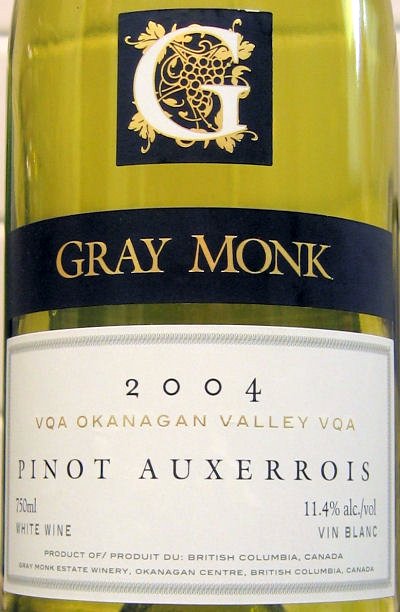
Gray Monk Pinot Auxerrois 2004
This Gray Monk Pinot Auxerrois from the Okanagan is "Delicious!", in our considered opinion. A bit of a gasoline (i.e., Riesling) scent, but thought it sounds odd to say so, that was OK. Very pale, almost grayish in colour. Tart peach flavours, a lingering finish. We would definitely buy this again, and we give it 8/10.
McWilliams Hanwood Estate Shiraz 2002

McWilliams Hanwood Estate Shiraz 2002
We don't have much to say about this McWilliams Hanwood Estate Shiraz: it's simply a good solid Shiraz, not as flavorful as the E&E Pepper Shiraz we really, really like, but flavorful enough, and with a very nice bouquet. Our rating out of 10: 6.5.
Sunday, September 18, 2005
McWilliam's Chardonnay Colombard 2004

McWilliam's Chardonnay Colombard 2004
This McWilliam's Chardonnay Colombard is nice and citrusy without too much oak, and with just the right amount of butteriness to the mouth feel--enough to let you know you're drinking a chardonnay without completely removing the crispness. Not particularly complex, but very pleasant to drink. Our rating out of 10: 6.5.
Deakin Estate Victoria Shiraz 2002

Deakin Estate Victoria Shiraz 2002
This Deakin Estate offering is a good, basic Shiraz, with lots of plum and black pepper flavour, and a pretty good match for spicy food. It's reasonably priced in Saskatchewan at about $12. Our rating: 6/10.
Cuvée Alice... Corbières 2003

Cuvée Alice... Corbières 2003
Well, we had to buy this one, didn't we, since both our four-year-old and Margaret Anne's mom are named Alice? We spotted it in Calgary and snapped up six bottles.
Ruby red in colour, well-balanced, fruity, but with a nice layer of tannin to keep it dry. A hint of strawberry in the flavour, perhaps. On the nose, wood, maybe cedar...certainly a more herby than floral bouquet. Margaret Anne really likes this one, rating it 9/10; Ed isn't quite as enthusiastic, but gives it a 7/10. Anyway, we'll definitely buy more of it (in fact, Ed will be in Calgary in the next few days and plans to pick up a couple more bottles), for the label, if nothing else!
Wednesday, August 24, 2005
Presto preservo!
Yes, we know, our title sounds like a Harry Potter spell. Nevertheless, this Preservo Wine Preservation Steward is a pretty cool looking gadget. It doesn't just pump the air out of your wine bottle, it actually blankets the wine with an inert gas to prevent futher oxidation. All for just $100! (Via Gizmodo.)
Saturday, August 13, 2005
Torreon de Paredes Cabernet Sauvignon 2000
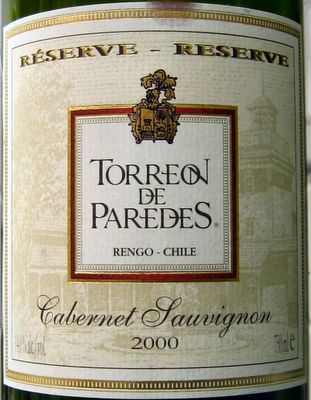
Torreon de Paredes Cabernet Sauvignon 2000
Margaret Anne particularly liked this Torreon de Paredes Cabernet Sauvignon from Rengo, Chile. It was a good "heavy," or sturdy wine, that stood up to strongly flavored food. Definitely not fruity. Margaret Anne rated it 8/10.
Hardy's Riesling Gewurztraminer 2004

Hardy's Riesling Gewurztraminer 2004
This Hardy's Riesling Gewurztraminer was more Riesling than Gewurztraminer to our taste, complete with a bit of that "diesel" smell that's the distinctive Riesling odor. (We know, we know, German winemakers hate it when you call that smell "diesel," but we don't mean it negatively.) Overall, pleasant, citrusy and crisp; not a particularly complex wine, but a good one for sipping and very food-friendly. Our rating: 7/10.
Subscribe to:
Posts (Atom)

